Aspirin, or acetylsalicylic acid, is one of the oldest medicines still in everyday use and one of the few that does two quite different jobs depending on the dose. At 300mg it is a painkiller and fever reducer, familiar to most Nigerians through Emprin and through the aspirin-and-caffeine sachet powders such as Alabukun that sell in enormous quantities in markets and motor parks. At 75mg or 100mg once a day it is not really a painkiller at all — it is a blood thinner, taken for years at a time to stop a second heart attack or stroke.
In the NAFDAC register
29 registered products
from 18 registration holders
What it costs online
about ₦13,800
≈₦322 per tablet (tablet/capsule)
0% since July 2026 · like-for-like
Sampled from 7 listings across MedPlus and Supermart.ng · October 2026
Full price breakdown →Brands of Aspirin in Nigeria
Comes as
- Tablet75 mg· 3 makers
Those 29 products from 18 registration holders, counted in our October 2026 copy of the register, include combination products and older listings; below are the most common brands.
| Brand Name | Manufacturer | Strength | Form | NAFDAC Reg. No. |
|---|---|---|---|---|
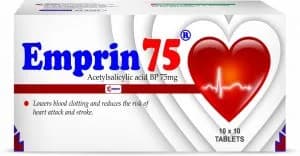 | Emzor Pharmaceutical Industries | 300mg | Tablet | 04-0264 |
| Avroprin-75 | Avro Pharma | 75mg | Tablet | A11-1095 |
| ASA 75 | SKG - Pharma | 75mg | Tablet | A4-2187 |
| Aspirin Cardio | Bayer Nigeria | 100mg | Tablet | A4-4447 |
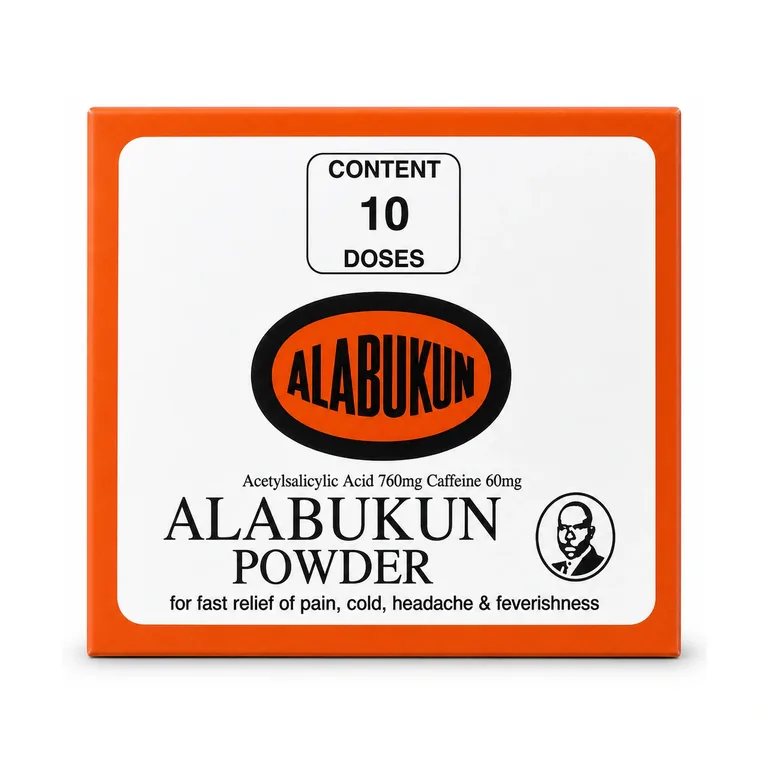 | Copac Nig Ltd | 760mg aspirin + 60mg caffeine | Powder | 04-0489 |
Aspirin Price in Nigeria
As of October 2026, Aspirin tablets sell for about ₦322 per tablet online in Nigeria (packs ₦7,000–₦29,550) at MedPlus and Supermart.ng. The online price is roughly unchanged since July 2026. Open-market prices (e.g. Idumota, Ogbogwu) are often lower.
Online retail (sampled)
₦7,000 for 56 tablets
₦13,400 for 56 tablets
Same 75mg Aspirin — 1.9× the price for an identical pack, so the difference is the brand.
median ₦13,800 · 7 listings
CheapestASPIRIN 75MG *56 TABS (ENTERIC-COATED)(MedPlus)
₦7,000PriciestBristol Aspirin 75 mg 56 Tablets(Supermart.ng)
₦13,4007 listings across MedPlus + Supermart.ng — brands and pack sizes vary · October 2026.
tablets: about ₦322 per tablet (₦125–₦677), from the 6 listings that state a pack size.
Unchanged since July 2026.
How to Verify Your Aspirin is Genuine
- 1Check for a NAFDAC registration number on the pack — every genuine aspirin brand sold in Nigeria must carry one
- 2Verify the number in the NAFDAC Green Book or the NAFDAC verification app, which is quick and free
- 3Check the strength before you buy: 75mg and 100mg are heart doses, 300mg is a painkiller dose, and the two are not interchangeable
- 4Buy from a licensed pharmacy or registered patent medicine vendor rather than a hawker, particularly for daily long-term use
- 5Check the expiry date and that the blister or sachet is intact; aspirin that smells strongly of vinegar has broken down and should be discarded
- 6For sachet powders, remember these are usually aspirin combined with caffeine — read the ingredients if you are already taking aspirin for your heart
Where to Buy
Listed sellers stocking Aspirin brands
As stated by each shop — not live inventory. Confirm availability with the shop, and verify the NAFDAC registration on any pack before you buy.
By market: Where to buy aspirin in Idumota Market, Lagos (1 seller)
Buying Aspirin wholesale, by the carton
Cartons of aspirin are bought at Nigeria's open drug markets: Idumota Market in Lagos, Ogbogwu Market in Onitsha, Ariaria Market in Aba and Sabon Gari Market in Kano. Each guide says where the market is and how to buy there safely; where we list sellers, they are named.
- Idumota Market, Lagos · wholesale sellers in Idumota Market — 1 listed seller here carries Aspirin brands
- Ogbogwu Market, Onitsha
- Ariaria Market, Aba
- Sabon Gari Market, Kano
Which one are you?
I'm buying aspirin
Tell us what you need and the quantity, and we'll connect you with a verified, NAFDAC-registered source. Free, no obligation.
I sell aspirin
Get a free page where buyers look for them: your products, your number, how to find your shop. Independent of NAFDAC and government. Nothing goes live until you have seen it and approved it. Why list? →
See a listed shop: Blessed Michael Pharmacy → · or sign up yourself →
Wherever you buy, buy only from licensed pharmacies and verified distributors — not roadside vendors — and verify the pack's NAFDAC registration before you pay. Buying Aspirin in bulk or for resale? See how to buy medicines in bulk in Nigeria safely.
Need Aspirin in bulk, or can't find it near you?
Tell us what you need and we'll connect you with a verified, NAFDAC-registered source.
What is Aspirin?
The difference is not marketing. Aspirin permanently switches off an enzyme inside platelets, the cells that make blood clot. A platelet cannot repair that damage, so a single small daily dose keeps the blood slightly less sticky for the platelet's whole lifespan of about a week. Higher doses add pain and inflammation relief by acting on the same enzyme elsewhere in the body, but they do not thin the blood any further — they only add to the risk of bleeding and stomach damage. This is why a cardiologist prescribes 75mg and not 300mg.
Aspirin is registered with NAFDAC in several forms in Nigeria, from locally made tablets by Emzor, Avro Pharma and SKG-Pharma to Bayer's imported Aspirin Cardio. It is sold over the counter, which is both its great advantage and its main danger: the people most likely to be harmed by it — those with ulcers, bleeding problems, or asthma, and children with a fever — can buy it as easily as anyone else.
What is Aspirin used for?
In Nigeria, Aspirin is commonly used for:
- Preventing a further heart attack, stroke or clot in people who have already had one (secondary prevention, 75-100mg daily)
- Keeping coronary stents open, almost always taken together with clopidogrel for a period after the procedure
- Emergency treatment during a suspected heart attack, where a single 300mg tablet is chewed while waiting for help
- Mild to moderate pain and fever at 300-600mg, including headache, toothache, period pain and muscular pain
- Reducing the risk of pre-eclampsia in pregnancies assessed as higher risk, at low dose and under antenatal supervision
Dosage
IMPORTANT
Always follow your doctor's or pharmacist's instructions. The information below is for general reference only.
Adults
For long-term heart and stroke protection the dose is 75mg to 100mg once daily, taken with or just after food. For pain or fever the dose is 300mg to 600mg every four to six hours, up to a maximum of 4g in twenty-four hours, and should not be continued for more than a few days without advice. In a suspected heart attack, a single 300mg tablet chewed rather than swallowed whole gets into the blood fastest — call for emergency help first, then chew it.
Children
Aspirin must not be given to children or teenagers under 16 with a fever or a viral illness such as flu or chickenpox, because of the risk of Reye's syndrome, a rare but frequently fatal swelling of the brain and liver. Use paracetamol or ibuprofen for children instead. The only exceptions are specific conditions such as Kawasaki disease, where a specialist prescribes and supervises it.
Elderly
Older adults get the same benefit from low-dose aspirin but bleed more easily, particularly from the stomach. Doctors often add a stomach-protecting medicine, and will weigh the bleeding risk carefully before starting aspirin in someone who has never had a heart attack or stroke.
Low-dose aspirin is a long-term medicine — it works by being taken every day, not by being taken when you feel unwell. Do not stop it on your own, especially in the first year after a stent, because stopping suddenly raises clot risk sharply. Take it with food to reduce stomach irritation, and swallow dispersible tablets dissolved in water. Tell any dentist, surgeon or doctor that you take aspirin before any procedure.
Side Effects
General information for a reader holding a pack, not a substitute for a doctor or pharmacist. If something on the serious list is happening, seek care now.
Common side effects
- •Stomach irritation, indigestion or heartburn — the most frequent reason people stop taking it
- •Nausea and mild abdominal discomfort
- •Bruising more easily than usual, and small cuts bleeding for longer
- •Nosebleeds and bleeding gums when brushing
- •Ringing in the ears (tinnitus), usually a sign the dose is too high
Serious side effects — seek medical help immediately
- Bleeding from the stomach or gut: black tarry stools, vomiting blood or material like coffee grounds, or severe stomach pain — seek care urgently
- Signs of bleeding in the brain: sudden severe headache, weakness on one side, confusion, or loss of vision or speech — this is an emergency
- Severe allergic reaction, including swelling of the face or throat, rash or collapse
- Wheezing or breathlessness in people with aspirin-sensitive asthma, which can be sudden and severe
- Reye's syndrome in a child or teenager given aspirin during a viral illness: persistent vomiting, drowsiness, confusion or seizures
When to see a doctor
Go to hospital immediately for black or tarry stools, vomiting blood, sudden severe headache, or one-sided weakness. Stop and seek advice if you develop wheezing after taking aspirin, or ringing in the ears. See your doctor or pharmacist if heartburn or stomach pain becomes a regular feature — that is treatable and is not a reason to quietly abandon a medicine protecting you from a stroke. Never give aspirin to a feverish child; if it has already been given and the child becomes drowsy or keeps vomiting, treat that as an emergency.
Warnings & Precautions
General information for a reader holding a pack, not a substitute for a doctor or pharmacist. If something on the serious list is happening, seek care now.
Do not take Aspirin if you have:
- Do not give to children or teenagers under 16 with fever or a viral illness, because of the risk of Reye's syndrome
- Do not take if you have an active stomach or duodenal ulcer, or a history of bleeding from the gut
- Do not take if you have haemophilia or another bleeding disorder, or severe liver or kidney disease
- Do not take if aspirin or another NSAID has ever caused you asthma, wheezing, hives or facial swelling
- Avoid in the last three months of pregnancy unless a doctor has specifically prescribed low-dose aspirin
Drug interactions
- •Warfarin and other anticoagulants — the combination raises bleeding risk substantially and needs medical supervision
- •Clopidogrel — deliberately combined after a stent, but only for a defined period decided by a cardiologist
- •Ibuprofen and other NSAIDs — regular use can block low-dose aspirin's heart protection and adds to stomach risk; take ibuprofen well after the aspirin if it is unavoidable
- •Methotrexate — aspirin raises its levels and toxicity
- •ACE inhibitors such as lisinopril, and diuretics — aspirin can blunt their effect and strain the kidneys
- •Alcohol — significantly increases the chance of stomach bleeding
- •Some diabetes medicines — aspirin at higher doses can lower blood sugar further
Pregnancy & Breastfeeding
Full-dose aspirin should be avoided in pregnancy, and particularly in the third trimester, where it can affect the baby's circulation and prolong labour and bleeding. Low-dose aspirin is a different matter: it is deliberately prescribed at antenatal clinics to women assessed as being at higher risk of pre-eclampsia, usually started before 16 weeks and continued until near delivery. Take low-dose aspirin in pregnancy only when a doctor or midwife has prescribed it, and do not start it on your own. Small amounts pass into breast milk, so regular aspirin is generally avoided while breastfeeding — paracetamol is the usual alternative.
Related Resources for Aspirin
Guides, articles, and tools related to Aspirin and other blood thinners medicines in Nigeria.
Frequently Asked Questions
Sources
- •NAFDAC Greenbook — the official database of all products registered with Nigeria's National Agency for Food and Drug Administration and Control. Brand-level NAFDAC numbers for Aspirin on this page were cross-referenced against the Greenbook.
- •WHO Model List of Essential Medicines — Aspirin is included in the WHO's list of essential medicines, meaning it is considered essential for basic healthcare needs.
- •British National Formulary (BNF) dosing and interaction guidance for Aspirin.
- •Nigerian Standard Treatment Guidelines (Federal Ministry of Health).
Daily puzzle: Meddle — pair five brands with their medicines. New game at midnight.